

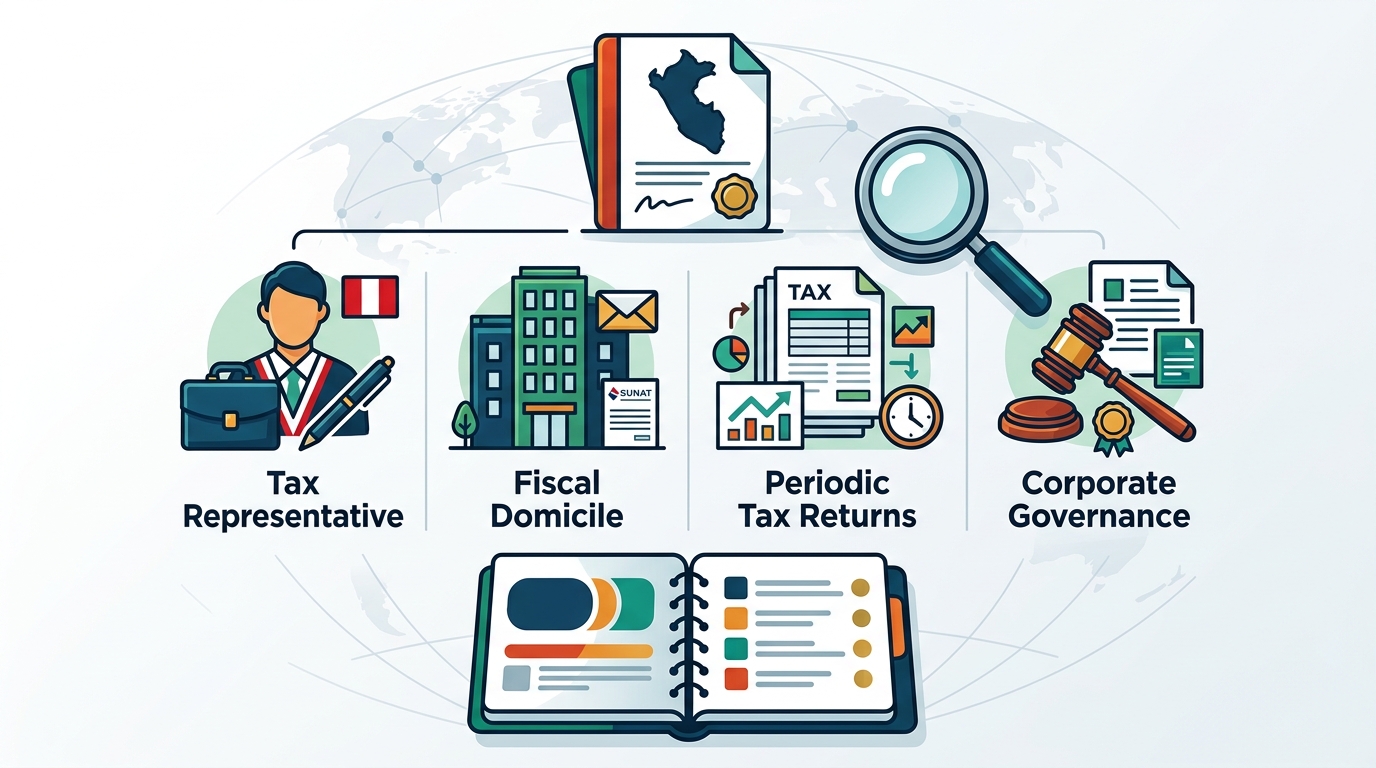
Foreign-owned companies in Peru must maintain an active tax representative, a registered fiscal domicile, and file periodic tax returns to remain in good standing. This guide details the specific obligations for IGV, income tax, and corporate governance. We explain how to manage these requirements remotely without relocating to Lima.
IGV Obligations
Impuesto General a las Ventas (IGV) is a value-added tax applied to the sale of goods and services in Peru. For a foreign-owned company, IGV compliance is the most frequent interaction with the tax authority, SUNAT. You must register as an IGV taxpayer if your annual sales exceed the threshold or if you choose to register voluntarily to issue credit notes.
Monthly Filing and Payment
Most companies file IGV returns monthly. The deadline is typically the 12th calendar day of the following month. If you sell services, you must issue electronic invoices (facturas electrónicas) through the SUNAT platform. Failure to issue these invoices correctly can result in fines and the inability to deduct expenses. The tax rate is generally 18%, though some services may be exempt or subject to a reduced rate.
Withholding Obligations
Companies often act as withholding agents for IGV when they pay for services provided by other businesses. You must withhold 18% of the service fee and remit it to SUNAT. This requires careful tracking of your suppliers. If you fail to withhold, you may be liable for the tax plus interest and penalties. Keeping your supplier data up to date in your accounting system is critical to avoid these errors.
Income Tax Filings
Corporate income tax in Peru is levied on the net profit of the company. The standard rate is 29.5%. This tax is calculated on the difference between total income and deductible expenses. Foreign-owned companies must file an annual income tax return, known as the Declaración Jurada, by the end of April of the following year.
Monthly Provisional Payments
Peruvian law requires companies to make monthly provisional payments of income tax. These payments are based on the previous year's profit or a fixed percentage of current income. The goal is to ensure that the annual tax liability is paid in installments rather than as a single lump sum. If your provisional payments are insufficient, you will owe interest on the difference. Accurate forecasting of your monthly profits is essential to manage cash flow effectively.
Annual Reconciliation
At the end of the fiscal year, you must reconcile your provisional payments against your actual tax liability. This involves preparing a detailed financial statement that complies with Peruvian accounting standards. The final return must be filed electronically. If you have a net loss, you may carry it forward to offset future profits, subject to specific limitations. Engaging a local accountant to prepare these filings is highly recommended to ensure accuracy and compliance with local regulations.
Annual Shareholder Meetings
Corporate governance in Peru requires regular shareholder meetings to approve financial statements and elect officers. For a Sociedad Anónima Cerrada (S.A.C.), the annual general meeting must be held within the first three months of the year. This meeting is mandatory for the company to remain in good standing with the corporate registry, SUNARP.
Agenda and Resolutions
The primary agenda items include the approval of the annual financial statements, the appointment of the General Manager, and the distribution of dividends. All resolutions must be recorded in the company's minutes book. This book must be legalized by a notary public. If you are a foreign shareholder, you can participate in these meetings remotely through a power of attorney. This allows you to vote and sign resolutions without traveling to Peru.
Legal Representation
Peruvian law requires every foreign-owned company to appoint a local legal representative. This individual acts on behalf of the company before SUNAT and other authorities. They must be a resident in Peru and have the legal capacity to sign documents. This is not a one-time appointment; the representative must remain active and compliant. If the representative resigns or fails to meet their obligations, the company may face sanctions. Maintaining a reliable local representative is a cornerstone of remote management.
Key Takeaways
- IGV is a monthly obligation requiring electronic invoicing and timely payment to SUNAT.
- Corporate income tax requires monthly provisional payments and an annual reconciliation by April.
- Annual shareholder meetings must be held and recorded in a legalized minutes book.
- A local legal representative is mandatory for all foreign-owned companies in Peru.
- Fiscal domicile must be a real address where official correspondence can be received.
- Remote management is possible through consular powers of attorney and local representatives.
- Non-compliance can lead to fines, interest, and the suspension of the company's legal status.
- Regular audits of your compliance calendar help prevent missed deadlines and penalties.
Frequently Asked Questions
Can I manage my Peruvian company entirely from abroad?
Yes, you can manage your company remotely. You need a local legal representative and a fiscal domicile. You can sign documents through a consular power of attorney. This allows you to make decisions without traveling to Lima.
What is the difference between a fiscal domicile and a registered office?
A fiscal domicile is the address registered with SUNAT for tax purposes. It must be a real location where you can receive official mail. A registered office is the address listed with SUNARP for corporate purposes. They can be the same, but the fiscal domicile is critical for tax compliance.
Do I need to be in Peru for the annual shareholder meeting?
No, you do not need to be physically present. You can appoint a local representative to attend and vote on your behalf. You must provide a power of attorney that grants them the authority to sign the minutes.
What happens if I miss a tax filing deadline?
If you miss a deadline, you will incur late payment interest and potential fines. SUNAT may also suspend your tax status, preventing you from issuing invoices. It is crucial to maintain a strict compliance calendar to avoid these issues.
Who can serve as my legal representative in Peru?
Your legal representative must be a resident in Peru with legal capacity. They can be an individual or a corporate entity. They must be willing to sign documents and act on behalf of the company before government authorities.
Is it possible to change my legal representative?
Yes, you can change your legal representative at any time. You must file the change with SUNAT and update your corporate records. The new representative must accept the appointment in writing. This process ensures continuity in your compliance obligations.
Conclusion
Operating a foreign-owned company in Peru requires a disciplined approach to compliance. You must manage IGV, income tax, and corporate governance obligations consistently. Peru Legal Setup provides the ongoing support you need to stay compliant without relocating. We handle your legal representation and fiscal domicile, allowing you to focus on growing your business. To plan your visit, for a free consultation.