

Incorporating a business in Peru involves registering a legal entity with SUNARP, obtaining a tax ID from SUNAT, and opening a bank account. The process typically takes 3 to 6 weeks and can be completed remotely. This guide covers the specific steps, costs, and legal requirements for foreign investors.
How to Choose a Legal Structure
Choosing the right entity is the first critical step. The Sociedad Anónima Cerrada (S.A.C.) is the most common structure for foreign investors. It is designed for closely held companies and does not require a board of directors. This structure allows for 100% foreign ownership in most sectors.
Why the S.A.C. is Preferred
The S.A.C. offers simpler governance compared to the standard S.A. (Corporation). It requires a minimum of two shareholders, though one can be a legal entity. This makes it ideal for subsidiaries or partnerships. The company incorporation service at Peru Legal Setup focuses on this structure for its efficiency.
Alternative Structures
For sole proprietors, the E.I.R.L. (Empresa Individual de Responsabilidad Limitada) is an option. It allows one natural person to own the company. However, it is less flexible for adding partners later. The S.A. is reserved for larger entities with public capital raising plans.
What to Ask Before Committing
Before signing any agreement, you must clarify the scope of services. Ask if the provider handles the entire process remotely. Confirm if they provide a real fiscal address or just a virtual one. Ask about the specific powers granted in the Power of Attorney.
Key Questions for Providers
- Do you handle the Consular Power of Attorney coordination?
- Is the fiscal domicile a real physical address in Lima?
- Do you provide ongoing legal representation for SUNAT?
- What is the timeline for each step of the registration?
Peru Legal Setup provides a free consultation to answer these questions before you commit to any service.
How to Verify Credentials
Verifying the legitimacy of your legal partner is essential. Check if the lawyer is registered with the Peruvian Bar Association. Verify the company's RUC (Tax ID) with SUNAT. Ensure the fiscal address is a real location, not a PO box.
Checking the Fiscal Address
A valid fiscal domicile must be a real address where official communications can be received. In Lima, this is often in Miraflores or San Isidro. You can verify the address by visiting it or requesting proof of lease. Peru Legal Setup provides a fiscal domicile service with a real registered address.
How the Process Works
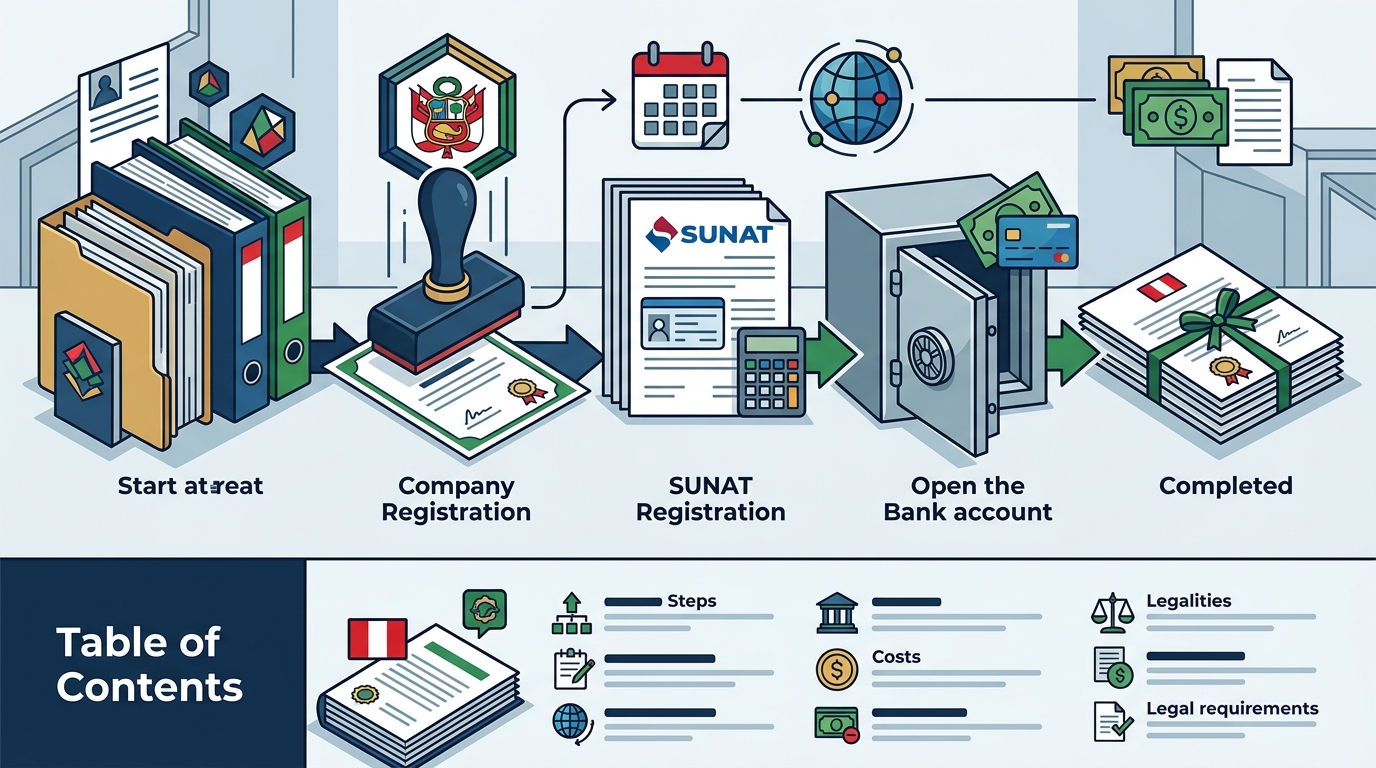
The incorporation process follows a strict sequence. It begins with the Power of Attorney and ends with the bank account opening. Each step must be completed in order to avoid delays.
Step-by-Step Breakdown
- Power of Attorney: Signed before a Peruvian Consulate abroad.
- Name Reservation: Checked and reserved with SUNARP.
- Bylaws Drafting: Defining purpose and capital.
- Public Deed: Signed before a notary in Lima.
- SUNARP Registration: Formal legal existence.
- RUC Issuance: Tax ID from SUNAT.
- Bank Account: Opening a corporate account.
A typical incorporation closes in 3 to 6 weeks. The set up a company in Peru guide details each step in depth.
What It Costs
Costs vary based on the structure and services required. The main expenses are government fees, notary fees, and professional service fees. Government fees are fixed, but professional fees depend on the complexity of the case.
Cost Components
| Item | Estimated Cost (USD) | Notes |
|---|
For a detailed breakdown, refer to the blog on incorporation costs.
Common Mistakes to Avoid
Many foreign investors make errors that delay or invalidate their incorporation. The most common mistake is using the wrong visa for the process. Another is failing to legalize corporate books.
Visa Confusion
A Business Visa does not allow paid work. If you plan to work in Peru, you need a Work Visa. Confusing these can lead to fines. The business or working visa guide explains the differences clearly.
Book Legalization
Peruvian law requires the legalization of the share register and minutes book. Failing to do this can prevent the company from operating legally. This step is often overlooked by first-time investors.
Incorporation vs. Branches
Opening a branch of a foreign company is an alternative to incorporating a local entity. A branch is not a separate legal entity; it is an extension of the parent company. This means the parent company is directly liable for the branch's debts.
Pros and Cons of Branches
Specific Scenarios
Different business models require different approaches. For example, a tech startup may need a different structure than a mining company. Sector-specific regulations can affect the process.
Miners and Extractive Industries
Miners must comply with additional environmental and labor regulations. The process is more complex and takes longer. Peru Legal Setup advises clients on the specific requirements for their sector.
Rules and Protections
Peruvian law provides strong protections for foreign investors. The Constitution guarantees the right to property and the freedom to conduct business. Foreigners have the same rights as Peruvian citizens in most sectors.
Investor Protections
Peru has bilateral investment treaties with many countries. These treaties provide additional protections against expropriation and ensure fair treatment. Investors can also access international arbitration if disputes arise.
Local Specifics in Lima
Lima is the primary hub for business in Peru. Most government offices, notaries, and banks are located in the capital. The fiscal address is typically in Miraflores or San Isidro, which are upscale districts with good infrastructure.
Why Lima Matters
Having a fiscal address in Lima simplifies the process. It ensures that official communications are received promptly. Peru Legal Setup provides a fiscal domicile in Lima to support this requirement.
Timing Your Incorporation
Timing is crucial for a smooth incorporation. The process takes 3 to 6 weeks, but this can vary based on the completeness of your documents. Starting the Power of Attorney early is key.
Optimal Timing
Begin the process at least 2 months before you plan to start operations. This allows time for any unexpected delays. It also gives you time to open a bank account and set up your systems.
Long-Term Results
Once incorporated, your company can operate indefinitely. The key to long-term success is maintaining compliance. This includes filing taxes, renewing the fiscal address, and keeping corporate books updated.
Ongoing Compliance
Peruvian corporate law requires an active tax representative and a registered fiscal domicile at all times. These are ongoing obligations. Peru Legal Setup offers periodical services to handle this compliance for you.
Key Takeaways
- The S.A.C. is the preferred structure for foreign investors in Peru.
- The incorporation process takes 3 to 6 weeks and can be done remotely.
- A real fiscal address in Lima is required for legal compliance.
- Business Visas do not allow paid work; Work Visas are required for employment.
- Corporate books must be legalized before a notary.
- Ongoing compliance requires a tax representative and fiscal domicile.
- Peru offers strong legal protections for foreign investors.
Frequently Asked Questions
Can I incorporate a company in Peru remotely?
Yes, you can incorporate a company in Peru entirely remotely. You will need to sign a Power of Attorney before a Peruvian Consulate in your home country. This allows a local representative to act on your behalf.
How long does it take to incorporate a company in Peru?
The process typically takes 3 to 6 weeks. This timeline includes the reservation of the name, drafting of bylaws, registration with SUNARP, and issuance of the RUC.
What is the minimum capital required for an S.A.C.?
There is no minimum capital requirement for an S.A.C. in Peru. You can start with a nominal amount, though you must deposit the declared capital into a bank account.
Do I need to be in Peru to open a bank account?
Some banks require the signatories to be present in person. However, some banks allow remote account opening with a Power of Attorney. It is best to check with the specific bank.
What is a fiscal domicile in Peru?
A fiscal domicile is the registered address of your company for tax purposes. It must be a real address where official communications from SUNAT can be received.
Can a foreigner own 100% of a company in Peru?
Yes, foreigners can own 100% of a company in most sectors. There are no local partner requirements for the S.A.C. structure.
Conclusion
Incorporating a business in Peru is a straightforward process if you follow the correct steps. By choosing the right structure, verifying your legal partner, and maintaining ongoing compliance, you can establish a successful presence in the Peruvian market. Peru Legal Setup provides the expertise and services you need to navigate this process remotely and with confidence.
To start your journey, book a free consultation with our team today.